Everything You Need to Know About API 6D Compliant Ball Valves for Petroleum, Chemical, and Pipeline Applications
An API Ball Valve is a quarter-turn industrial valve that uses a spherical ball with a cylindrical bore to control fluid flow in pipelines . The ball rotates 90 degrees to either align its bore with the pipeline (open position) or block the flow path with its solid surface (closed position).
The operating principle is simple and reliable:
A hollow ball with a bore (full bore or reduced bore) is positioned between two sealing seats
When open, the bore aligns with the pipeline axis—fluid flows straight through with minimal pressure drop
When closed, the ball rotates 90° so the solid surface blocks the flow path
A stem connects the ball to an operator (handle, gear, or actuator)
Seats (typically PTFE, Nylon, PEEK, or metal) provide bubble-tight sealing around the ball

API 6D is the definitive standard for pipeline valves used in petroleum and natural gas industries . It covers:
Design requirements – Pressure-temperature ratings, materials, dimensions
Construction specifications – Body and trim materials, end connections
Testing and inspection – Shell test, seat test, low-pressure and high-pressure closure tests
Marking and documentation – Valve identification, material traceability
Valves built to API 6D are recognized globally for their reliability, durability, and suitability for high-pressure pipeline service.
Key Characteristics of API Ball Valves:
| Feature | Description |
| API 6D Compliance | The definitive standard for pipeline valves in petroleum and natural gas industries—covers design, materials, dimensions, testing, and marking |
| Quarter-Turn Operation | 90° rotation from fully open to fully closed—fast, simple operation for emergency shutdown |
| Bubble-Tight Shut-Off | Resilient or metal seats provide zero leakage when closed—meets API 598 seat test requirements |
| Full Bore or Reduced Bore Options | Full bore for pigging and minimal pressure drop; reduced bore for lower cost and smaller envelope |
| Fire-Safe Design | Secondary metal seats maintain shut-off if primary soft seats are damaged in a fire—complies with API 607 and API 6FA |
| Trunnion or Floating Ball Design | Floating ball for smaller diameters/lower pressures; trunnion-mounted ball for large diameters/high pressures |
Design Configurations
API ball valves are available in several design configurations to suit different applications. The choice between full bore vs. reduced bore and floating vs. trunnion-mounted designs significantly impacts performance, cost, and maintenance.
| Parameter | Full Bore (Full Port) | Reduced Bore (Regular Port) |
| Bore Diameter | Matches pipeline inside diameter | Smaller than pipeline ID |
| Flow Resistance | Minimal—virtually no pressure drop | Moderate—restriction creates some pressure drop |
| Pigging Capability | Yes—allows pipeline pigs to pass through freely | No—restricted bore blocks pig passage |
| Cost | Higher | Lower |
| Weight | Heavier | Lighter |
| Best For | Piggable pipelines, high flow efficiency, minimal pressure drop | General isolation where pigging is not required, cost-sensitive applications |
According to API 6D, a reduced bore ball valve typically has one size reduction for sizes up to 12″, and two size reductions for sizes 14″ to 24″ . For full-bore valves, the bore diameter should be at least 90% of the inside diameter of the valve end as per ASME B16.34 .

| Parameter | Floating Ball | Trunnion-Mounted Ball |
| Ball Support | Ball floats between upstream and downstream seats—pressure pushes ball against downstream seat for sealing | Ball is fixed by top and bottom stem supports (trunnions) that absorb line pressure |
| Sealing Mechanism | Line pressure forces ball against downstream seat—higher pressure equals tighter seal | Springs push seats against ball—operating torque independent of line pressure |
| Operating Torque | Higher (ball must overcome seat friction under pressure) | Lower (trunnions absorb pressure, seats move independently) |
| Pressure Range | Class 150–900 (lower) | Class 150–2500 (higher) |
| Diameter Range | DN15–DN200 (small to medium) | DN200–DN1400 (large) |
| Best For | Small diameters, lower pressures, cost-effective applications | Large diameters, high pressures, demanding pipeline service |
| Seat Material | Temperature Range | Chemical Resistance | Best For |
| PTFE / RTFE | -200°C to +200°C | Excellent | General oil, gas, water, chemical—excellent low-friction sealing |
| Nylon | -30°C to +120°C | Good | Higher temperature capability, wear resistance |
| PEEK | -50°C to +250°C | Excellent | High temperature, high pressure, demanding chemical service |
| Metal (Hardfaced) | -50°C to +600°C | Depends on metal | High temperature, abrasive media, fire-safe applications |
The choice of body material is critical for compatibility with the media, operating temperature, and pressure.
| Material Grade | Best For | Key Characteristics |
| WCB / A105 | General oil, gas, water, steam—moderate temperatures | Standard carbon steel—most common, cost-effective, good strength |
| LCB / LF2 | Low-temperature service (down to -46°C) | Low-temperature carbon steel—impact-tested for cold environments |
| CF8 (F304) | General corrosive service, oxidizing acids | 18Cr-8Ni stainless steel—good corrosion resistance |
| CF8M (F316) | Aggressive corrosive service, chloride environments | 18Cr-10Ni-2Mo—molybdenum improves chloride/pitting resistance |
| F51 (Duplex) | High-chloride, seawater, sour gas service | Excellent chloride stress corrosion resistance, high strength |
For sour service containing H₂S and/or CO₂, NACE MR0175/MR0103 compliance is required . Material grades such as LF2 (low-temperature), F304, and F316 with NACE compliance are available for corrosive service.
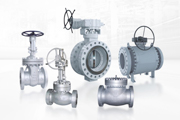
WEIZIDOM’s API Ball Valve is engineered specifically for oil, gas, and demanding pipeline applications, providing rapid, reliable isolation under high pressure and challenging conditions.
Outstanding Features and Advantages:
API 6D & GB/T12237 Compliance – Manufactured to recognized petroleum industry and Chinese national standards—ensures design integrity, dimensional interchangeability, rigorous testing, and global acceptance for pipeline and process applications.
Exceptional Diameter & Pressure Range (DN15–DN1400, Class 150–2500) – Covers everything from small instrument isolation (DN15) to major pipeline block valves (DN1400) and from medium-pressure (Class 150) to ultra-high-pressure (Class 2500) applications—a single valve family for projects across the entire oil and gas industry.
Quarter-Turn Operation – Fast Shut-Off – 90° rotation from fully open to fully closed enables rapid response in emergency situations—critical for pipeline safety and emergency shutdown (ESD) systems.
Bubble-Tight Shut-Off – Precision-machined ball and resilient seats (PTFE, Nylon, PEEK) provide zero leakage when closed—meets API 598 seat test requirements for positive isolation of hazardous fluids.
Full Bore or Reduced Bore Options – Full bore provides unobstructed flow path for pigging and minimal pressure drop; reduced bore offers lower cost and smaller envelope.
Trunnion or Floating Ball Design – Floating ball design (DN15–DN200) for cost-effective operation; trunnion-mounted ball (DN200–DN1400) with top and bottom stem supports absorbs line pressure, reducing operating torque in large diameters.
Fire-Safe Design – Secondary metal seats maintain shut-off if primary soft seats are damaged in a fire—complies with API 607 and API 6FA fire test standards.
Double Block and Bleed Capability – Provides positive isolation from both upstream and downstream pressure—critical for hazardous fluid service.

API ball valves are widely used across the petroleum, chemical, hydropower, and gas and liquid pipeline transportation industries.
Typical Applications:
| Application Field | Specific Use |
| Natural Gas Pipelines | Transmission line block valves, city gate stations, compressor station bypass |
| Liquefied Petroleum Gas (LPG) Systems | Storage tank isolation, loading systems, vapor return lines |
| Crude Oil & Refined Product Pipelines | Pump station isolation, mainline block valves, tank farm piping |
| Petrochemical Plants | Reactor feed, product transfer, utility isolation |
| Chemical Processing | Corrosive and hazardous fluid handling |
| Hydropower & Industrial Water Systems | High-pressure penstock isolation, cooling water systems |
Pipeline Shut-Off (On/Off Service) – Provides reliable, bubble-tight isolation of natural gas, LPG, oil, and other hydrocarbon pipelines—quarter-turn operation enables rapid closure in emergency situations .
Emergency Shutdown (ESD) – Quick 90° operation allows immediate shut-off of flow during emergency conditions—critical for safety systems in gas and liquid pipelines .
Sectionalizing Transmission Pipelines – Divides long-distance oil and gas pipelines into manageable segments—allows maintenance, repair, or isolation without draining entire lines .
Wellhead and Manifold Flow Control – Used in wellhead trees and manifold systems to direct or isolate flow from multiple wells—provides positive shut-off for well workover operations .
Loading and Unloading Systems – Installed on truck loading racks, railcar loading systems, and marine loading arms—provides reliable shut-off during product transfer operations .
When selecting an API ball valve for your specific application, consider the following criteria in order:
Match the valve’s pressure class (Class 150–2500) to the system’s maximum operating pressure
Ensure the valve’s temperature range (typically -46°C to +150°C for standard designs) covers your operating conditions
Identify all chemicals, their concentrations, and the presence of chlorides (Cl⁻) or H₂S/CO₂
For sour service (H₂S/CO₂), select NACE MR0175/MR0103 compliant materials
Choose Floating Ball for DN15–DN200, lower pressures, cost-effective applications
Choose Trunnion-Mounted Ball for DN200–DN1400, high pressures, large diameters, lower torque
Choose Full Bore for piggable pipelines, minimal pressure drop, high flow efficiency
Choose Reduced Bore for general isolation where pigging is not required, lower cost
PTFE/RTFE – General oil, gas, water, chemical service—excellent low-friction sealing
Nylon – Higher temperature capability, wear resistance
PEEK – High temperature, high pressure, demanding chemical service
Metal (Hardfaced) – High temperature, abrasive media, fire-safe applications
Flanged (ASME B16.5) – Standard pipeline and process connections
Butt Weld (ASME B16.25) – Permanent pipeline installations, reduced leakage paths
Socket Weld / Threaded – Small diameter, high pressure, instrument connections
Manual (handle or gear) – For local, infrequent operation
Pneumatic – For fast, remote on/off control
Electric – For precise control and integration with DCS/SCADA systems

| Parameter | Options | Typical Application |
| Bore Size | Full Bore (Full Port) / Reduced Bore (Regular Port) | Full bore for pigging and minimal pressure drop; reduced for lower cost |
| Ball Support | Floating Ball / Trunnion-Mounted Ball | Floating for DN15–DN200; trunnion for DN200+ and high pressure |
| Seat Material | PTFE / Nylon / PEEK / Metal | Standard; high-temperature; high-pressure; fire-safe |
| End Connections | Flanged / Butt Weld / Socket Weld / Threaded | Standard process; permanent pipeline; instrument connections |
| Fire-Safe Design | Primary soft seats + secondary metal seats | Required in oil, gas, and petrochemical fire-safe applications |
API ball valves manufactured to API 6D undergo rigorous testing to ensure performance and reliability . WEIZIDOM’s API valves undergo strict quality control procedures including:
Raw material inspection – Chemical and mechanical testing to verify material compliance
Shell test – Hydrostatic pressure test to verify body and bonnet integrity
Seat test – Low-pressure and high-pressure closure tests to verify bubble-tight shut-off
Fire-safety test – Compliance with API 607 and API 6FA for fire-safe designs
Each valve receives comprehensive inspection before delivery, with traceable quality documentation meeting international oil and gas project audit requirements .
| Application | Recommended Configuration | Key Selection Factor |
| Gas Pipelines | Trunnion, Full Bore, PTFE seats | API 6D compliance, full bore for pigging |
| Wellhead & Upstream | Floating/Trunnion, NACE MR0175, metal seats | High pressure, sour service (H₂S/CO₂) |
| Refining & Petrochemical | Trunnion, fire-safe, metal/PTFE seats | High temperature, fire-safety, corrosion resistance |
| Chemical Processing | Corrosive media, stainless steel body, PTFE seats | Corrosion resistance, bubble-tight shut-off |
| Low-Temperature / LNG | LF2/F316 material, cryogenic design | Impact-tested materials for low temperature |
API ball valves are among the most trusted isolation valves in the oil and gas industry, offering fast quarter-turn operation, bubble-tight shut-off, and exceptional reliability in demanding pipeline and process applications. Manufactured to API 6D standards, these valves provide the design integrity, material traceability, and rigorous testing required for critical oil and gas service.
By understanding the differences between full bore vs reduced bore, floating vs trunnion-mounted ball, and seat material options, engineers and procurement professionals can select the right API ball valve for their specific application—ensuring safety, reliability, and long service life.